
CITIES ON DEMAND? UNBOXING URBAN UN_CERTAINTIES FROM AMAZON’S ALGORITHMIC ARCHITECTURES AND FORECASTED FUTURES
[ongoing since 2022, Leuphana University Lüneburg]
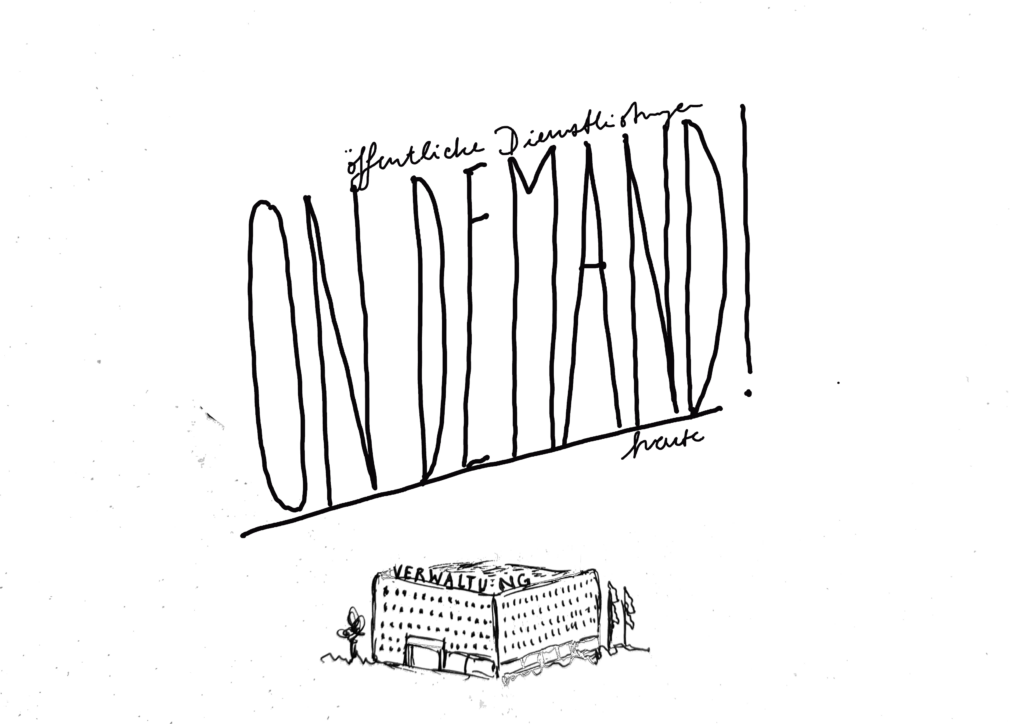
In today’s technocapitalist cities, big tech companies have become neighbors, employers, and even critical public infrastructure providers – a standard in modern urban life. Though their technologies promise to make austerity-ridden cities ‘smarter’ and to improve administrative efficiency, tech monopolists are really battling over who will control and profit from shaping future urban narratives. They achieve this by experimenting with and gradually taking over urban environments, increasingly eliminating uncertainty and securing outcomes that serve their interests.
One of these ‘future-makers’ is the tech company Amazon. Often only perceived as ‘virtual warehouse’, the corporation has long been extending its power: in addition to being a retail giant, Amazon is increasingly organizing (smart) cities around its last mile logistics and running hugely profitable data centers as a partner to public governments. By lobbying for and providing certain services, Amazon has now become rather infrastructural. On its second biggest market, Germany, it offers future disaster relief and private substitutions of welfare goods. In other words, Amazon uses current uncertainties as powerful governing strategy. Its security gadgets only feed further insecurities of its customers, thus establishing a profitable pipeline of predictable behavior to reign over spaces, capital, and futures. But what kind of ‘cities of certainties’ result from these manufactured uncertainties, who are they for, and what kind of future do they represent?
In my Ph.D. research project, I am interested in the tense negotiations around the design of (public) infrastructures between private tech actors like Amazon; local administrations; and urbanites. Drawing on three ethnographic case studies – from Amazon’s smart home devices, its urban technologistical zoning strategies, to its cloud services – the project empirically explores how uncertainties of our time are politically instrumentalized by tech companies to fit their business and design defaults and enclose the potential of diverse digitized cities. Critically and creatively ‘unboxing’ Amazon’s future-making practices in Hamburg, the Ruhr region, and Brandenburg, my research asks how the public sector and citizens are dealing with, questioning, and perhaps even sabotaging the current ‘city-on-demand’-culture of Big Tech. How can they regain power about public discourses around futures in the race to care for democracy and a broken planet?
SELECTION OF MY WORK RELATED TO MY DISSERTATION:
Voigt, Maja-Lee (submitted): AmaZon_e of Interest – Urban Development “On Demand” at the Back and Front End of Technocapitalist Cities. In: CITY.
Voigt, Maja-Lee (2026): AmaZon(e) of Interest – Warum wir unsere kritischen Infrastrukturen gegen Big Tech verteidigen müssen. re:publica 2026. May 18, Berlin.
Amazon(e) of Interest Graphics (2026)
Koss, Sarah Yolanda (2026): Von der Kohle zur KI – und wieder zurück nd.digital. Published on July 23, 2026.
Voigt, Maja-Lee (2025): Mapping Amazon’s Logistical Footprint on the Ruhr – How a Tech Company is Influencing Cities, Cluster Politics, and Climates. In: Platforms & Society, 2.
Voigt, Maja-Lee (2024): Unboxing Amazon – How Amazon is taking over (public) infrastructures and why we should care. re:publica 2024. May 27, Berlin.
Voigt, Maja-Lee (2024): Amazon: Wie der Versandhändler unsere Infrastruktur kontrolliert. Politisches Feuilleton, Deutschlandfunk Kultur. Aired October 7, 2024.